Wednesday, March 25, 2015

Richard Volz

Innovation in Plain Sight 
by Alex Lipoff

Multiple choice question: If you were to walk into Rich Volz’s classroom, you might immediately notice: 

A) Some of the last remaining chalk boards anywhere in the school that line the walls on three sides.
B) The missing presence of any projectors, monitor screens, gizmos, etc. 
C) Weekly itineraries for all of his class sections, with their assignments posted and dated in advance, stapled to the board.
D) Innovation happening everywhere.
E) All of the above. 

At a purely surface level, Mr. Volz’s classroom wouldn’t necessarily strike the casual observer as a place full of innovation and creativity. Where are the pricey high-tech screens and gadgets, and where is there room in his pre-planned curriculum for those impromptu and ingenious innovative lessons that seem to spring from the top of a teacher’s head and materialize in an exciting new class project?

Yet, as Amanda Ripley writes in The Smartest Kids in the World: And How They Got That Way, “Old school can be good school” (214). Every cycle since the beginning of the school year, students in Mr. Volz’s classes have been experimenting with creative writing exercises. Rather than simply innovating for the sake of innovation, Mr. Volz has been encouraging his students to use creative approaches to reinforce and solidify the content and skills that have been covered. “The most successful one was the first one I did,” he said. “We were reading The Odyssey and had really belabored the themes and patterns in the text, so the creative writing served a great purpose at that point. Students were asked to rewrite a story to invert the themes of the text, and by doing that, they obviously had to show that they understood the original content and were able to manipulate it in a way that would flip it on its head.”

Similarly, Mr. Volz has been asking students to write poems about the grammar rules the class has covered as a way of studying and memorizing what would otherwise be a fairly dry and inflexible subject matter.

Andres Schleicher, originator of the PISA test, believes that “[i]n most of the highest-performing systems, technology is remarkably absent from classrooms.” While the stereotype is often that the innovative lesson is something completely different from anything the teacher has tried before, Mr. Volz’s class is a testament to the inherent innovation that occurs in any classroom: “I teach the same texts each year, but I don’t think I’ve ever taught the same text the same way. We find new things, new passages and themes, to focus on and emphasize each time. That to me is innovation. It’s the same text, it’s the same material, but we’re going to twist it around and see it from a different angle. I ask myself: ‘What will renew this material for each of my students on an individual level? How do I give them a new understanding?’ That is innovation.”

Wednesday, March 4, 2015

Ryan Hews

Scrapbooking American Lives
by Patty Garrison

Scrapbooking, the popular hobby, is taking on a new look in Ryan Hews' U.S. History class. Instead of the usual approach of constructing a representation of one's own life, Mr. Hews' students are busy creating a scrapbook of memories and artifacts of a fictional family that they invent. This is the "American Lives" project, which is designed by Mr. Hews to foster skills of collaboration and creativity. Additionally, and just as importantly, he allows the students a powerful learning opportunity as they "witness" history and "write the story from a personal perspective."

Here is how the project works: students form groups that collectively decide their fictional families' names and places of origin. Then, they follow this family through each stage of history that is studied in Mr. Hews' class. The rules are that no actual historical event can be changed, and no fictional character can impact the course of history; therefore, students need to conduct careful research in order to remain historically correct, yet they must also rely on their creativity to connect their families to history. They craft, develop, and gather artifacts that represent the families' experiences. These artifacts are displayed in the scrapbooks, which represent how these fictional families move, interact, and are impacted by the events of American history. For example, a family that has moved to New York State in the pre-Civil War years may experience a moral change of perspective regarding the rights of women due to the Seneca Falls Convention. The students will research the convention, decide on how their family has been changed, collect evidence of the change to display in the scrapbook, and ultimately gain a deep understanding of the issues of that period of history.

Mr. Hews says that he begins the year in U.S. History with a discussion of the events of 9/11/2001. He believes that in order for the students to fully comprehend the depth of that impact, they must first understand our country's story. Thus, the creation of the scrapbook, chronicling the journey of their fictional families, allows the students to connect in a much more personal way to United States history. The scrapbooks end at 9/11, bringing the students full circle with a much greater appreciation for the impact of historical events on the population of a country.

In The Smartest Kids in the World and How They Got That Way, Amanda Ripley includes an appendix about how to recognize great teaching. In it, she says, sometimes learning happens in noisy places where the kids are working in groups without much input from the teacher. Some of the worst classrooms are quiet, tidy places that look, to adults, reassuringly calm." In the video below, you can catch a glimpse of this in action, as the students work through their projects individually, with Mr. Hews offering feedback to those who need it. 


Monday, March 2, 2015

Lynn McNulty

The Ugly Sweater Project
by Lucie-Knight Santos

I first heard about Lynn McNulty’s Ugly Christmas French Revolution/Napoleon sweater project last year, and I immediately thought that it would be a perfect subject for The Blue Sky Project blog. Well, actually that’s a little bit of a lie. My first reaction was to be really jealous of all the students who would get to take part in this awesome quest for tackiness involving two of my favorite subjects. I mean, who can resist a revolution that lead to the groundbreaking concept of “Liberté, Égalité, Fraternité,” or a man who crowned himself Emperor?

The goal of the project, according to Ms. McNulty, was for her AP European History students to think about these events in a totally different way and create a three-dimensional experience of their own vision. They were given the task of carefully selecting at least 8 props to put on their sweater with the understanding that, in the world of ugly sweaters, more is almost always better. They were also given the option of choosing a theme, such as the evolution of Jacques-Louis David’s paintings or feminist issues throughout the revolutionary period. Students brave enough to wear their sweaters all day on the due date and get pictures with Mr. Hews, Dr. Gillin, and Mr. Brougham were given extra credit. They were then responsible for explaining their choice of props to the class. The result, as you can see below, was amazing!


Friday, February 6, 2015

Anthony Cannuli

Making Thinking Visible
by Ted Shaffner

Anthony Cannuli has made innovation in the classroom his highest priority this year. As the teacher of eighth-grade English, Mr. Cannuli has been looking for ways to make his teaching more student-centered. In order to do this, he has been applying a number of protocols from the book, Making Thinking Visible, by Ron Ritchhart, Mark Church and Karin Morrison. In the video below, you can see Mr. Cannuli talk about several of these protocols - including Chalk Talk, Sentence-Phrase-Word, and Freeze Frame - and how his students have responded to them. He has also created activities of his own, capitalizing on the kinetic energy that his students have. These activities seem applicable to many different subjects and grade levels, and are a great way to put students in charge of their own education. I will definitely be using some of these in my classes!


Wednesday, January 28, 2015

Todd Loffredo

Challenging Our Fears
by Dana Radanovic

For this week's innovation spotlight, Dana Radanovic has written about Todd Loffredo in a way that can't be translated directly onto a blog. So please click the link to view the file. Don't worry - no viruses! Just a little puzzle for you to work out.

Thursday, January 22, 2015

Pauline McKean

Closing the Distance
by Mark Davies

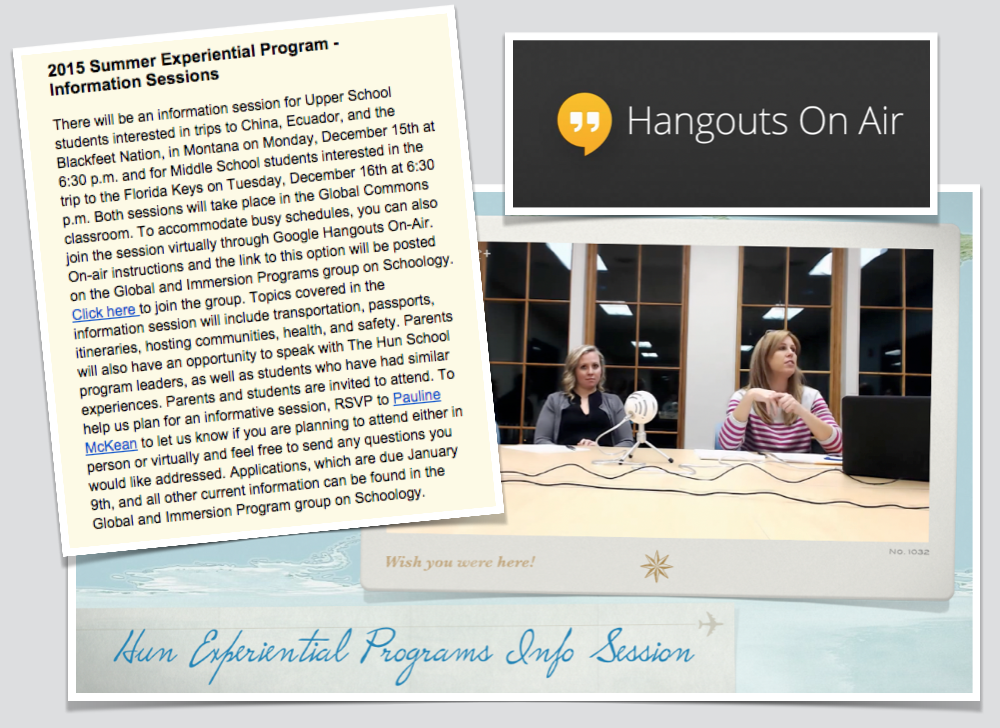
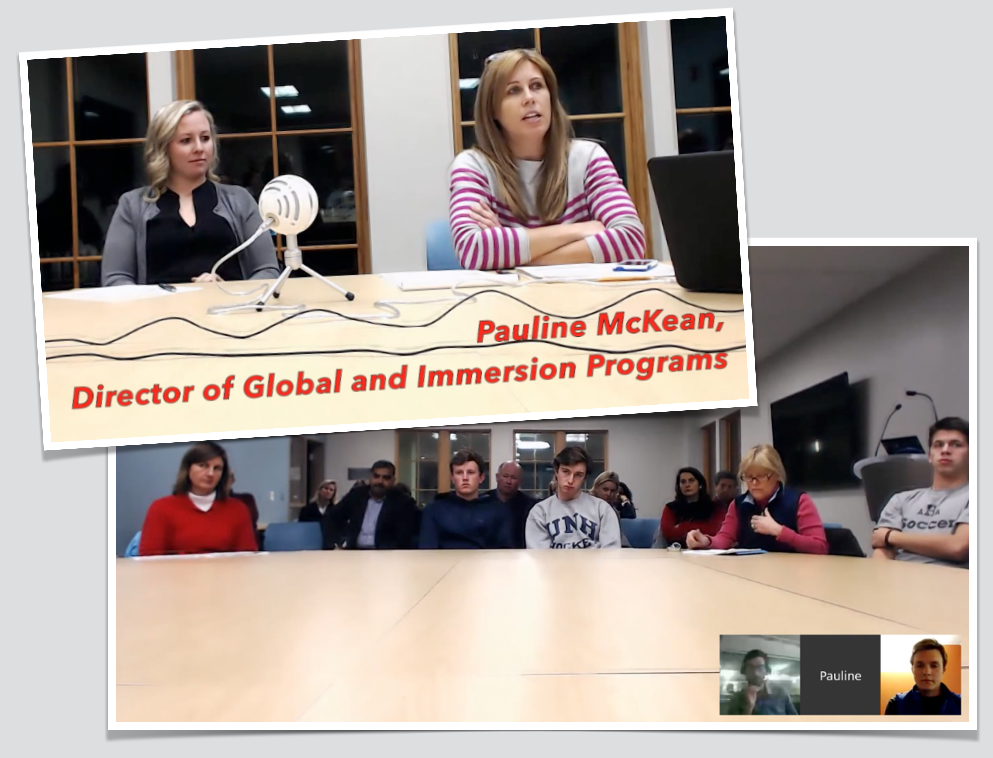
This summer, The Hun School’s new Global and Immersion Programs will be offering students the opportunity to participate in three very different Experiential Learning opportunities. Students can choose from immersive living experiences in China, Ecuador or the Blackfeet Nation in Montana. Pauline McKean, Director of Global and Immersion Programs, needed to introduce the programs to as many prospective families as possible and offer them the chance to get their questions answered. 

There were three significant problems. First, there was the challenge of getting parents and students to show up for an evening meeting, on campus. The second problem was that representatives from our China program partners, Where There Be Dragons, were two time zones away, in Colorado. The third potential impediment was the fact that the installation of our brand new high tech classroom’s video conferencing system was not going to be completed by the date of the meeting.

The solution: Google Hangouts On Air.

Hangouts On Air is similar to other video conferencing services such as Skype or FaceTime except it allows users to live-stream their video to the world via YouTube. All you need is a digital device with a camera and mic, a Google Plus account, and a good internet connection. Additionally, Hangouts On Air has built-in features like the ability for anyone viewing the video online to remotely submit questions to the people who are in the live conference. Also, Hangouts On Air automatically posts the video of the conference on YouTube so it can be watched after the fact for those who could not see it in real time.

After a quick test run with our Colorado partners, Ms. McKean got the word out to the Hun community via the weekly ebulletin and Schoology to let students and parents know that the Experiential Programs Info Session would be held at 6:30 in the new classroom in the Global Commons and available online for anyone who could not attend in person. The fact that the new classroom’s high tech video conferencing system was not yet operational was inconsequential. Ms. McKean had a working laptop with camera and mic and a solid internet connection. The session started on time at 6:30 and ran for about an hour as she introduced the Hun faculty trip leaders and our partners from Where There Be Dragons, explained the programs, and fielded questions from the audience in attendance - both online and in person.

Knowing that our new Global Commons high tech classroom would offer us access to real cutting edge video conferencing capabilities, the Experiential Programs Info Session seemed like the perfect opportunity to connect local, on campus students and families with other families who couldn’t make the meeting in person, and connect with our experiential learning partners off site, across the country. It also seemed like a great opportunity for Hun to showcase our new facilities and cutting edge technology. When we realized that our new classroom audio and video systems would actually not be online in time for the meeting, the easy and - some would argue - prudent thing to do would be to remove that remote participation aspect entirely. But when offered the chance to leverage earlier successes in her classroom using Google Video Hangouts and extend that by trying a Hangout On Air for the information session, Ms. McKean embraced the opportunity despite the discomfort that was inherent in being an early adopter and in taking a risk. 

You can watch the video yourself at the link below:

View info session on YouTube

The video has been viewed more than 60 times in the two months since it was first posted and multiple families have submitted applications for the three experiential programs this summer.


Wednesday, January 14, 2015

Lisa Yacomelli

Putting Hamlet on Trial
by Tiberiu Dragoiu-Luca

This week, the Blue Sky Project features two classroom innovations by Lisa Yacomelli: her Senior Trial and her iMovie project based on The Adventures of Huckleberry Finn.

Students who participate in the Senior Trial are engaged in the creation of a legal hypothetical based on literature they read, and they then choose either the prosecution or the defense based on the legal issues. Class members demonstrate collaborative problem solving as they assemble textual evidence to support and present their arguments in a collectively written “brief." They share responsibility and learn to work effectively and cooperatively as they present these arguments orally in the culminating trial. This project teaches students to work collaboratively as they critically examine world issues as related to the literature, plus it gives them a bit of a glimpse into a real-life working situation. Past trials have examined Hamlet’s sanity, Victor Frankenstein’s parental neglect, and literary censorship by the Republic of Gilead in The Handmaid's Tale.

The second project is a hybrid between Student Centered Learning and Digital Literacy. The class progresses to an open-ended essential question discussion, conducted in the Harkness method, during which students identify themes they can then relate to their own lives or apply to situations and problems they may encounter. The students divide into four groups, and each group selects one of those themes. Then each group uses an iPad or laptop to demonstrate its understanding of the theme, and then extend this to contemporary life. For example, one group examined superstition in The Adventures of Huckleberry Finn, and then included movie clips demonstrating modern superstitions, as well as interviews with students and teachers regarding whether or not they have superstitious beliefs. The entire unit takes about a month, and culminates in a popcorn and movie day! The project helps promote not only student understanding of the book, but also increases students’ ability to express themselves through digital media.

Below is a video interview with Ms. Yacomelli, including one of the Huck Finn student projects.