Friday, February 6, 2015

Anthony Cannuli

Making Thinking Visible
by Ted Shaffner

Anthony Cannuli has made innovation in the classroom his highest priority this year. As the teacher of eighth-grade English, Mr. Cannuli has been looking for ways to make his teaching more student-centered. In order to do this, he has been applying a number of protocols from the book, Making Thinking Visible, by Ron Ritchhart, Mark Church and Karin Morrison. In the video below, you can see Mr. Cannuli talk about several of these protocols - including Chalk Talk, Sentence-Phrase-Word, and Freeze Frame - and how his students have responded to them. He has also created activities of his own, capitalizing on the kinetic energy that his students have. These activities seem applicable to many different subjects and grade levels, and are a great way to put students in charge of their own education. I will definitely be using some of these in my classes!


Wednesday, January 28, 2015

Todd Loffredo

Challenging Our Fears
by Dana Radanovic

For this week's innovation spotlight, Dana Radanovic has written about Todd Loffredo in a way that can't be translated directly onto a blog. So please click the link to view the file. Don't worry - no viruses! Just a little puzzle for you to work out.

Thursday, January 22, 2015

Pauline McKean

Closing the Distance
by Mark Davies

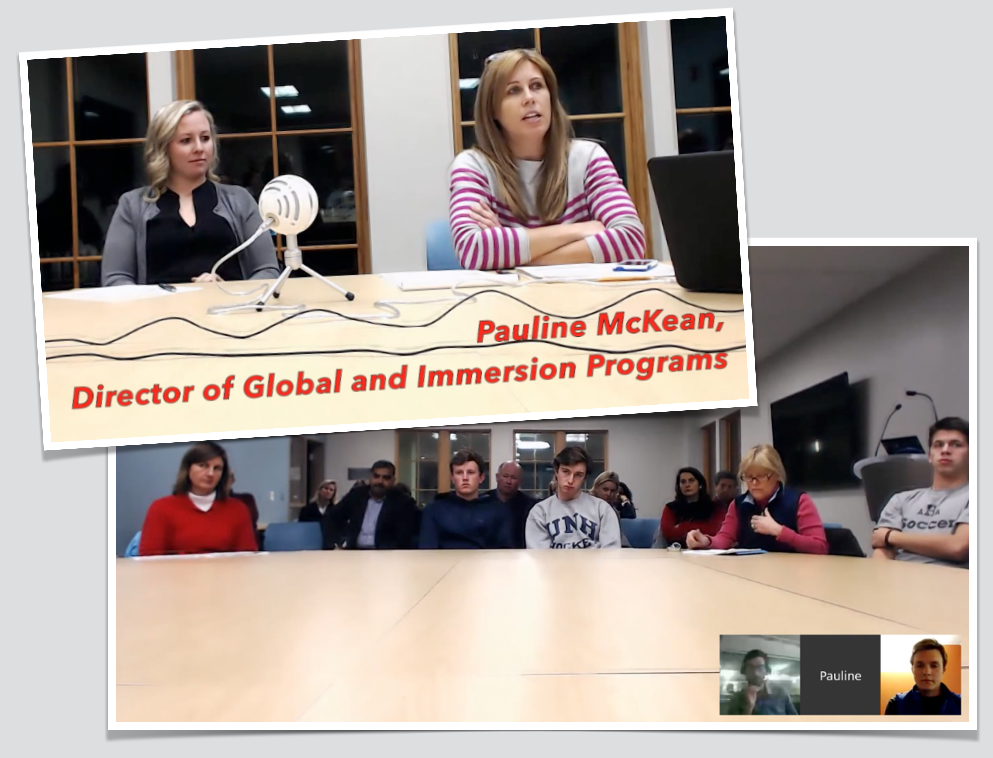
This summer, The Hun School’s new Global and Immersion Programs will be offering students the opportunity to participate in three very different Experiential Learning opportunities. Students can choose from immersive living experiences in China, Ecuador or the Blackfeet Nation in Montana. Pauline McKean, Director of Global and Immersion Programs, needed to introduce the programs to as many prospective families as possible and offer them the chance to get their questions answered. 

There were three significant problems. First, there was the challenge of getting parents and students to show up for an evening meeting, on campus. The second problem was that representatives from our China program partners, Where There Be Dragons, were two time zones away, in Colorado. The third potential impediment was the fact that the installation of our brand new high tech classroom’s video conferencing system was not going to be completed by the date of the meeting.

The solution: Google Hangouts On Air.

Hangouts On Air is similar to other video conferencing services such as Skype or FaceTime except it allows users to live-stream their video to the world via YouTube. All you need is a digital device with a camera and mic, a Google Plus account, and a good internet connection. Additionally, Hangouts On Air has built-in features like the ability for anyone viewing the video online to remotely submit questions to the people who are in the live conference. Also, Hangouts On Air automatically posts the video of the conference on YouTube so it can be watched after the fact for those who could not see it in real time.

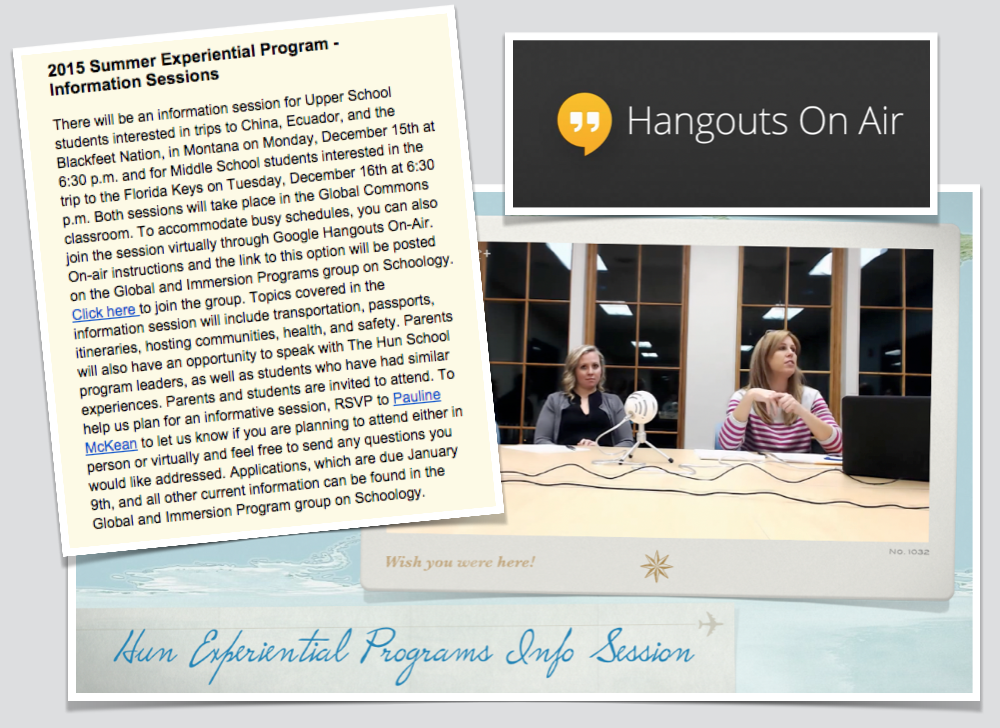
After a quick test run with our Colorado partners, Ms. McKean got the word out to the Hun community via the weekly ebulletin and Schoology to let students and parents know that the Experiential Programs Info Session would be held at 6:30 in the new classroom in the Global Commons and available online for anyone who could not attend in person. The fact that the new classroom’s high tech video conferencing system was not yet operational was inconsequential. Ms. McKean had a working laptop with camera and mic and a solid internet connection. The session started on time at 6:30 and ran for about an hour as she introduced the Hun faculty trip leaders and our partners from Where There Be Dragons, explained the programs, and fielded questions from the audience in attendance - both online and in person.

Knowing that our new Global Commons high tech classroom would offer us access to real cutting edge video conferencing capabilities, the Experiential Programs Info Session seemed like the perfect opportunity to connect local, on campus students and families with other families who couldn’t make the meeting in person, and connect with our experiential learning partners off site, across the country. It also seemed like a great opportunity for Hun to showcase our new facilities and cutting edge technology. When we realized that our new classroom audio and video systems would actually not be online in time for the meeting, the easy and - some would argue - prudent thing to do would be to remove that remote participation aspect entirely. But when offered the chance to leverage earlier successes in her classroom using Google Video Hangouts and extend that by trying a Hangout On Air for the information session, Ms. McKean embraced the opportunity despite the discomfort that was inherent in being an early adopter and in taking a risk. 

You can watch the video yourself at the link below:

View info session on YouTube

The video has been viewed more than 60 times in the two months since it was first posted and multiple families have submitted applications for the three experiential programs this summer.


Wednesday, January 14, 2015

Lisa Yacomelli

Putting Hamlet on Trial
by Tiberiu Dragoiu-Luca

This week, the Blue Sky Project features two classroom innovations by Lisa Yacomelli: her Senior Trial and her iMovie project based on The Adventures of Huckleberry Finn.

Students who participate in the Senior Trial are engaged in the creation of a legal hypothetical based on literature they read, and they then choose either the prosecution or the defense based on the legal issues. Class members demonstrate collaborative problem solving as they assemble textual evidence to support and present their arguments in a collectively written “brief." They share responsibility and learn to work effectively and cooperatively as they present these arguments orally in the culminating trial. This project teaches students to work collaboratively as they critically examine world issues as related to the literature, plus it gives them a bit of a glimpse into a real-life working situation. Past trials have examined Hamlet’s sanity, Victor Frankenstein’s parental neglect, and literary censorship by the Republic of Gilead in The Handmaid's Tale.

The second project is a hybrid between Student Centered Learning and Digital Literacy. The class progresses to an open-ended essential question discussion, conducted in the Harkness method, during which students identify themes they can then relate to their own lives or apply to situations and problems they may encounter. The students divide into four groups, and each group selects one of those themes. Then each group uses an iPad or laptop to demonstrate its understanding of the theme, and then extend this to contemporary life. For example, one group examined superstition in The Adventures of Huckleberry Finn, and then included movie clips demonstrating modern superstitions, as well as interviews with students and teachers regarding whether or not they have superstitious beliefs. The entire unit takes about a month, and culminates in a popcorn and movie day! The project helps promote not only student understanding of the book, but also increases students’ ability to express themselves through digital media.

Below is a video interview with Ms. Yacomelli, including one of the Huck Finn student projects.


Tuesday, December 16, 2014

Kate Butler

The Principle of Expected Value
by Lucie Knight-Santos

Earlier this year, when the Blue Sky Project first began, we took the opportunity in our cohort meetings to ask about the innovative methods our fellow “cohorters” were using in their classes. Ms. Kate Butler told me about the work she was doing with her Probability and Statistics class involving the game of Roulette and the Principle of Expected Value. As someone who is the farthest possible from being a math genius, I was fascinated and decided to take this opportunity to find out more about the unique methods that she uses to teach this class.

The Principle of Expected Value predicts what return a player can expect if they bet one dollar. For example, in the game of Roulette, you can expect to lose 5.3 cents on every dollar bet. Knowing this, students can then calculate what each bet is worth if the player wins. Since Roulette involves different kinds of bets, such as placing a bet on a single value or only even numbers, students have their work cut out for them calculating the expected return on dozens of different bets that a player can make in this particular game. In Ms. Butler’s class, the students first play an electronic version of the game on an app and then discuss the different types of bets possible, especially the riskier kinds of bets such as a bet placed on one number. They then go through the bets and calculate the probability of winning and the expected pay out. They receive one chip, place bets and keep a running tally of their winnings and losses to check the validity of their own calculations.

Ms. Butler has designed this Probability and Statistics class keeping the students, who tend to find math challenging, very much in mind. The classes focusing on the Principle of Expected Value and Roulette form part of a larger theme that has students learning how to calculate the expected value of games, varying from Blackjack to the Lottery and The Price is Right. The latter game forms an entire unit towards the end of the year that involves students creating simulations of their own games, that they then play and track the results to see if their data matches up with their own calculations. Last year, students created their own Plinko games that they took around campus and asked other students to play, betting - for example - hugs or high fives.

In creating these classes, Ms. Butler has successfully turned these games into an effective and fun teaching tool that engages even the most challenged and skeptical math learners (myself included)!

Tuesday, December 9, 2014

Alex Lipoff

Shark Tanks & Fantasy Football
by Ted Shaffner

We talk a lot about student-centered learning these days, and at times, it's hard to get a handle on precisely what that means. Alex Lipoff spends a great deal of his time working this out and performing a wide variety of experiments to test the concept fully. In his seminar class, he allows students to determine a large portion of the actual curriculum, and finds in the process that he is still able to teach the essential skills for higher order thinking and communicating. In the video below, you can see him talk about three of his experiments, including the Seminar Passion Project, a student feedback exercise based on the television show, Shark Tank, and a Harkness reflection exercise based on Fantasy Football. You will also hear him talk about modeling risk taking, focusing on skills-based learning, and the difficulties and potential messiness of innovation in the classroom.


The creative mind at work is impressive here, but even more important is how thoughtful Mr. Lipoff is about balancing content and skills, and how willing he is to inspire and follow the trail his students want to forge with him. I have been lucky enough to observe his classes and discuss his ideas at length, and I felt others should be able to share in this opportunity. I have learned a great deal from him, and plan to adapt some of these projects into my own lesson plans.

Wednesday, December 3, 2014

Laura Bishop

Creating a Library and Media Center For the 21st Century
by Melissa Dorfman

Laura Bishop has dived right in to her new position as Director of the Library and Media Center at Hun. She started her first year by introducing students and teachers to new and creative ways to approach their projects and research assignments.

Ms. Bishop credits attending inspiring conferences such as the Education Information Technology Conference earlier in her career, and the innovative people she met there, for introducing her to some of the “must haves” for a 21st Century Library and Media Center.

Lib Guides is one of the most important tools our Media Center Director feels she has implemented so far at Hun. This organizational tool for digital data keeps information for projects, learning about a particular theme or topic, and guides to research in one place. Ms. Bishop introduced my students to Lib guides as what she calls a “one stop shop” to find all instructions, printed materials, and data bases that our library has to offer, relating to our topic of an imaginary trip through Central America. After research is completed using the help of the individualized guide for the project, students can post their project right on the guide itself. From start to finish, Lib Guide allows students to create their projects with ease. 


Thanks to Ms. Bishop, some Hun students have also already been using the “Questia” app for advanced work and research. It contains thousands of ebooks that unlimited users around the country and the world can use at the same time. Students have their own folders and can highlight and take notes while they are reading. Here is a Youtube video Ms. Bishop created to make using Questia as user friendly as possible for our students and faculty.


Finally, our art courses have been enhanced with the the Artstor app. It is a repository of images and works from around the world. Ms. Bishop says excitedly, “You can see the brushstrokes in the pieces.” This allows students to easily compare and contrast some of the world’s greatest artists. Check out Mona Lisa from Artstor!


From my perspective as a very grateful teacher whose students have benefited from the new resources Laura Bishop has brought to our Library, I am very excited about the new opportunities for learning she has brought to Hun. I know we all look forward to continued collaboration with her to help enhance our students’ learning experience at our School. She is excited about what students can do in her library, and the enthusiasm is contagious for all who work with her.