Wednesday, June 3, 2015

Mark Davies

Computer Science, Online Learning, Differentiated Instruction
by Mark Davies

This year, The Hun School of Princeton offered computer programming classes to upper school students in a differentiated instruction, blended learning environment.


There are many models of online and blended learning. Some schools join a consortium, like Global Online Academy. This kind of membership gives students access to a whole catalog of courses that are taught, in most cases, entirely online. GOA’s model also requires faculty from member schools to participate as instructors, teaching a course online to students from other consortium schools. Other models, like Online School for Girls or Laurel Springs School, allow students to take a single course or attend school entirely online.


The benefits of online and blended learning are many, but one of the greatest appeals of this model is the opportunity to provide students with a learning experience that is not currently provided by their school. Not every school can provide a classes in multivariable calculus, app design, or neuropsychology,but most schools have at least some students with the interest and aptitude for these kinds of courses.


"The term blended learning is defined by the International Association for K-12 Online Learning (iNACOL) as: “any time a student learns at least in part at a supervised brick-and-mortar location away from home and at least in part through online delivery with some element of student control over time, place, path, and/or pace; often used synonymously with Hybrid Learning.”


At Hun, it had been a challenge to consistently provide classes in computer programming, but with the blended learning opportunity provided as a CodeHS member school, we were able to accomplish this task, and we were able to do so while meeting a wide range of student ability.
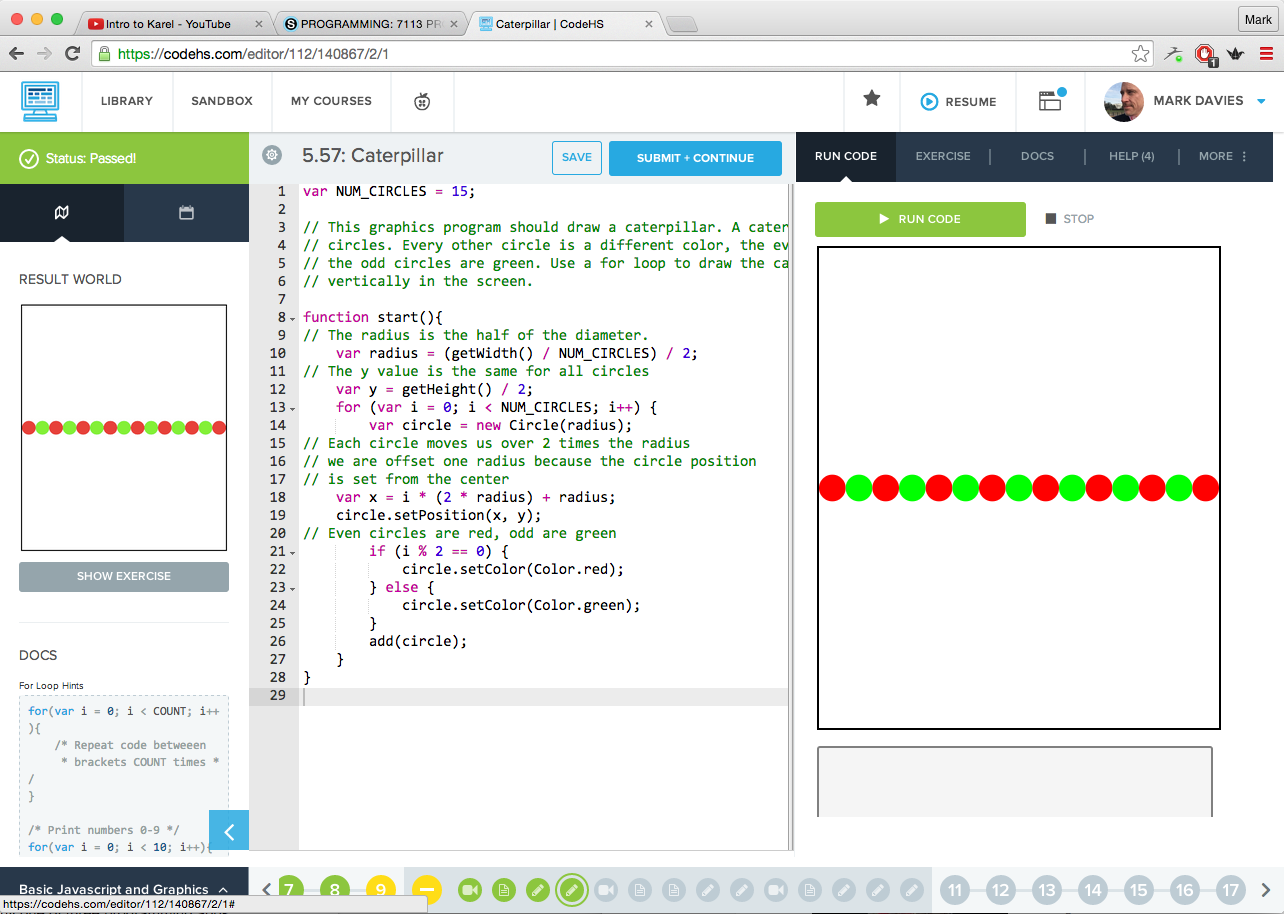

CodeHS was started by a pair of Stanford University Computer Science majors in 2012, their senior year at Stanford. They based CodeHS on their experience as section leaders and teaching assistants for several Stanford’s introductory computer science classes. The curriculum is delivered entirely online. Students watch demonstration videos and complete programming activities in the online code editor that runs in Google Chrome. They are provided feedback by online tutors and graded on their work with the CodeHS gradebook feature. As the class teacher, I am also provided the same access to lessons and tutor support, and I am provided sample syllabi and other supporting materials. 


In addition to the course content from CodeHS, students worked on programming challenges with a small mechanical orb called Sphero. Sphero can be remotely controlled by an iOS or Android application, and it can also be programmed with any one of three programming apps; orbBasic, MacroLab, or Tickle. Programming the Sphero device provided an opportunity for students to actually use the introductory programming applications, concepts, and practices in a less abstract context.


Our programming class time was either spent working independently on CodeHS activities, reviewing CodeHS lessons with PearDeck as a whole group, or working in small groups on Sphero programming. Our once-per-cycle extended class time was perfect for Sphero related work. We often used the large room that was formerly our student activity center where students could spread out and work in pairs or small groups designing and completing Sphero challenge tasks and offering feedback to other groups on their activity designs. The final project for the semester involved students making those real world connections to computer science concepts through Sphero programming.


Truly differentiated learning was another benefit of the blended learning experience with CodeHS. Students who were motivated and capable could work ahead and extend their learning while getting valuable feedback and support from the online tutors - feedback and support they would not have otherwise gotten from a traditional classroom instruction model. Students who were not as inclined to work ahead and who generally worked “at pace” also had their needs met as we took the time in class to review lessons and activities as we completed them online. Also, there was considerable opportunity for peer support as students worked in class, sharing with each other insights and strategies for completing the programming challenges.


Tiberiu Dragoiu-Luca

Around the World in 80 Days
by Ted Shaffner

In his physics class, Tiberiu Dragoiu-Luca has the students do a project where they design a trip around the world, which allows students to learn and practice skills related to his course material -- such as kinematics, acceleration and deceleration, uniform and harmonic motion -- and also to explore different global locations through their trip planning. In the video below, he describes his project, and we also hear from some of the students who have completed the project. The students clearly feel that this is different from many other science projects they have, because they have more ability to express their personalities, but also practice the skills they learn in class.


Friday, May 1, 2015

Bernard Lockhart-Gilroy

Potential Unlimited
by Joan Roux

Edward de Bono, a proponent of teaching thinking as a subject in schools, would endorse the Extended Lab Project (XLP) that Bernard Lockhart-Gilroy’s AP Physics students undertake in the second semester as they are tasked to ask a definitive and quantifiable question that can be answered by a 15 week experiment.

De Bono believes creativity involves breaking out of established patterns in order to look at things in a different way. As the titles of some of these projects suggest, the students rose to the challenge:

Potential Unlimited:
the first steps of building a pipe organ.
“Kinematics of a Pneumatic Spud Gun: Pressure v. Distance”
(Fast food takes on a whole new meaning…)

“’I’m sorry Dave, I’m afraid I can’t do that’: Optimizing an Autonomous Programmed Robot”
(The contrary robot!)

“A Laser Pointer Becomes A Laser Gun”
(‘Lethal Weapon 6’?)

“Tesla Coil Symphony” and the “PVC Pipe Organ”
(Performing arts meet science.)

Students work in groups of 3, and each group has a budget of $100.00 per person to purchase materials to conduct the experiment and/or build the final product. Ingenuity and cost effectiveness go hand in hand as students are encouraged to use equipment already in the possession of the Hun School.

The scope of these projects is as ambitious as the students who attempt them. However, reality checks exist in the form of peer reviewers who will use a rubric to do occasional checks. A project could be “advancing rapidly and effectively,” “making solid but unspectacular progress,” or in the worst case-scenario, be in “imminent danger of collapse.”

In order to keep things fair, the reviewers are also assessed by the instructor, and their contribution could range from “helpful and insightful” to “vague and useless.” What goes around comes around…

From conception to completion, the Extra Lab Project constitutes a proposal and an interview, and research followed by lab design and execution. Students then submit a report accompanied by a lab journal. The final step is a 5 – 7 minute presentation.

Here is what junior Ajay Vasisht says:
"The XLP Pipe Organ Project has been a huge learning experience. I have to be involved in every aspect of the project, from managing the budget, to researching theories, to buying and shaping the tubes, to creating and analyzing data. The experience certainly has brought out the best in each group member, as every long period we are given 90 minutes to work without teacher supervision."

Thursday, April 23, 2015

Blair Buck

Innovative Thinking For Better Writing In The Sciences
by Melissa Dorfman

Blair Buck used the technology that brings educators from all over together, known as the AP Biology list serve, to read about a writing process called “CER” (Claim, Evidence, Reasoning). He was looking to improve the writing of his 9th graders, many of whom were having trouble writing complete explanations to answer his essay questions. This scaffolding process guides students through the logical thinking process. The question that students had to answer and provide evidence for was, “Should Mendelian Genetics be taught in high school class?”

Mr. Buck says that using this process has made the students’ responses more cohesive and persuasive than prior essays once they were guided into supporting how their evidence backs up their claims and relates to underlying scientific principles. Mr. Buck pulled from several different sources (BSCS and NSTA) to put his activity together and to get his students solving his question on Mendelian Genetics. He also provided several supporting worksheets and a sample problem to provide students with practice at working through this process. Here is one such sheet that Mr. Buck used to explain the CER process and give some examples of how it is used. Mr. Buck continues to show, along with others previously highlighted in this blog, that some of the best technology for being innovative exists in our heads. The most important thing is how we are trained to use it!

Wednesday, March 25, 2015

Richard Volz

Innovation in Plain Sight 
by Alex Lipoff

Multiple choice question: If you were to walk into Rich Volz’s classroom, you might immediately notice: 

A) Some of the last remaining chalk boards anywhere in the school that line the walls on three sides.
B) The missing presence of any projectors, monitor screens, gizmos, etc. 
C) Weekly itineraries for all of his class sections, with their assignments posted and dated in advance, stapled to the board.
D) Innovation happening everywhere.
E) All of the above. 

At a purely surface level, Mr. Volz’s classroom wouldn’t necessarily strike the casual observer as a place full of innovation and creativity. Where are the pricey high-tech screens and gadgets, and where is there room in his pre-planned curriculum for those impromptu and ingenious innovative lessons that seem to spring from the top of a teacher’s head and materialize in an exciting new class project?

Yet, as Amanda Ripley writes in The Smartest Kids in the World: And How They Got That Way, “Old school can be good school” (214). Every cycle since the beginning of the school year, students in Mr. Volz’s classes have been experimenting with creative writing exercises. Rather than simply innovating for the sake of innovation, Mr. Volz has been encouraging his students to use creative approaches to reinforce and solidify the content and skills that have been covered. “The most successful one was the first one I did,” he said. “We were reading The Odyssey and had really belabored the themes and patterns in the text, so the creative writing served a great purpose at that point. Students were asked to rewrite a story to invert the themes of the text, and by doing that, they obviously had to show that they understood the original content and were able to manipulate it in a way that would flip it on its head.”

Similarly, Mr. Volz has been asking students to write poems about the grammar rules the class has covered as a way of studying and memorizing what would otherwise be a fairly dry and inflexible subject matter.

Andres Schleicher, originator of the PISA test, believes that “[i]n most of the highest-performing systems, technology is remarkably absent from classrooms.” While the stereotype is often that the innovative lesson is something completely different from anything the teacher has tried before, Mr. Volz’s class is a testament to the inherent innovation that occurs in any classroom: “I teach the same texts each year, but I don’t think I’ve ever taught the same text the same way. We find new things, new passages and themes, to focus on and emphasize each time. That to me is innovation. It’s the same text, it’s the same material, but we’re going to twist it around and see it from a different angle. I ask myself: ‘What will renew this material for each of my students on an individual level? How do I give them a new understanding?’ That is innovation.”

Wednesday, March 4, 2015

Ryan Hews

Scrapbooking American Lives
by Patty Garrison

Scrapbooking, the popular hobby, is taking on a new look in Ryan Hews' U.S. History class. Instead of the usual approach of constructing a representation of one's own life, Mr. Hews' students are busy creating a scrapbook of memories and artifacts of a fictional family that they invent. This is the "American Lives" project, which is designed by Mr. Hews to foster skills of collaboration and creativity. Additionally, and just as importantly, he allows the students a powerful learning opportunity as they "witness" history and "write the story from a personal perspective."

Here is how the project works: students form groups that collectively decide their fictional families' names and places of origin. Then, they follow this family through each stage of history that is studied in Mr. Hews' class. The rules are that no actual historical event can be changed, and no fictional character can impact the course of history; therefore, students need to conduct careful research in order to remain historically correct, yet they must also rely on their creativity to connect their families to history. They craft, develop, and gather artifacts that represent the families' experiences. These artifacts are displayed in the scrapbooks, which represent how these fictional families move, interact, and are impacted by the events of American history. For example, a family that has moved to New York State in the pre-Civil War years may experience a moral change of perspective regarding the rights of women due to the Seneca Falls Convention. The students will research the convention, decide on how their family has been changed, collect evidence of the change to display in the scrapbook, and ultimately gain a deep understanding of the issues of that period of history.

Mr. Hews says that he begins the year in U.S. History with a discussion of the events of 9/11/2001. He believes that in order for the students to fully comprehend the depth of that impact, they must first understand our country's story. Thus, the creation of the scrapbook, chronicling the journey of their fictional families, allows the students to connect in a much more personal way to United States history. The scrapbooks end at 9/11, bringing the students full circle with a much greater appreciation for the impact of historical events on the population of a country.

In The Smartest Kids in the World and How They Got That Way, Amanda Ripley includes an appendix about how to recognize great teaching. In it, she says, sometimes learning happens in noisy places where the kids are working in groups without much input from the teacher. Some of the worst classrooms are quiet, tidy places that look, to adults, reassuringly calm." In the video below, you can catch a glimpse of this in action, as the students work through their projects individually, with Mr. Hews offering feedback to those who need it. 


Monday, March 2, 2015

Lynn McNulty

The Ugly Sweater Project
by Lucie-Knight Santos

I first heard about Lynn McNulty’s Ugly Christmas French Revolution/Napoleon sweater project last year, and I immediately thought that it would be a perfect subject for The Blue Sky Project blog. Well, actually that’s a little bit of a lie. My first reaction was to be really jealous of all the students who would get to take part in this awesome quest for tackiness involving two of my favorite subjects. I mean, who can resist a revolution that lead to the groundbreaking concept of “Liberté, Égalité, Fraternité,” or a man who crowned himself Emperor?

The goal of the project, according to Ms. McNulty, was for her AP European History students to think about these events in a totally different way and create a three-dimensional experience of their own vision. They were given the task of carefully selecting at least 8 props to put on their sweater with the understanding that, in the world of ugly sweaters, more is almost always better. They were also given the option of choosing a theme, such as the evolution of Jacques-Louis David’s paintings or feminist issues throughout the revolutionary period. Students brave enough to wear their sweaters all day on the due date and get pictures with Mr. Hews, Dr. Gillin, and Mr. Brougham were given extra credit. They were then responsible for explaining their choice of props to the class. The result, as you can see below, was amazing!